How Peptides Are Stored
Peptide storage can seem confusing because recommendations aren’t the same for every peptide. Temperature, light, moisture, and whether a peptide is still in its dry form or has been placed into solution can all affect stability, so understanding the basics can help make sense of the different storage guidelines you may see.
Why Does Peptide Storage Matter?
Peptides are chains of amino acids that can change or break down when exposed to certain conditions. Heat, moisture, light, and repeated temperature changes may all affect stability over time. Proper storage helps protect the integrity of the material so researchers can be more confident that what they are studying has remained as close as possible to its original state.
Not every peptide is equally sensitive, which is why storage recommendations can vary. The specific peptide, its form, and how long it will be stored all play a role in determining the appropriate conditions.
How Are Research Peptides Usually Stored?
Many research peptides are supplied as a dry, freeze-dried powder known as a lyophilized peptide. Removing water generally helps improve stability, which makes this form useful for storage and transportation.
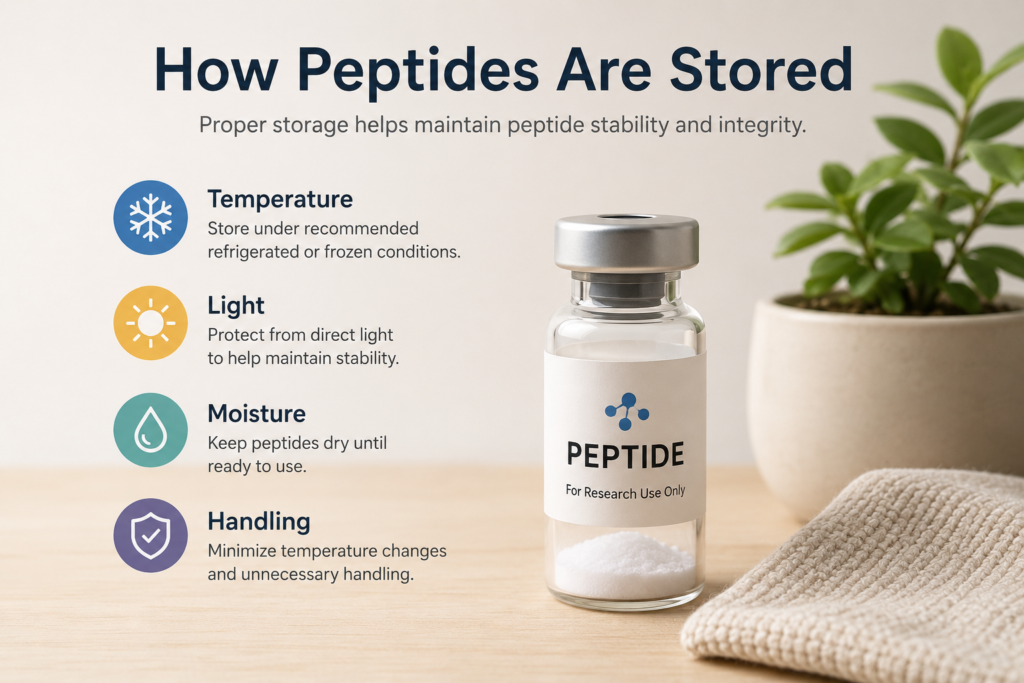
Storage requirements vary, but researchers commonly consider:
Because peptides differ, storage information provided for the specific material should take priority over a general rule that applies to peptides as a whole.
Lyophilized Peptides vs. Peptides in Solution
One of the biggest differences in peptide storage comes down to whether the peptide is still dry or has been placed into solution. A lyophilized peptide has had most of its water removed, which generally makes it more stable than the same peptide in liquid form.
Once a peptide is dissolved, its stability can change because water creates an environment where certain chemical reactions and degradation processes can occur more easily. This is why a peptide may have one set of storage recommendations while lyophilized and another after it has been prepared in solution.
What Changes Once a Peptide Is in Solution?
Once a peptide is dissolved, storage becomes more important because the peptide is now interacting with water and may be more susceptible to degradation.
This is also why storage recommendations for a lyophilized peptide and a prepared peptide solution may be different. A dry peptide may remain stable under conditions that aren’t appropriate once that same material has been dissolved.
Researchers therefore consider both what the peptide is and what form it is currently in when determining appropriate storage conditions.
Do Peptides Need to Be Refrigerated?
Refrigeration is commonly associated with peptide storage, but it isn’t a universal requirement for every peptide in every situation. The appropriate temperature depends on the peptide, its form, the expected storage period, and the stability information available for that material.
Consistency can matter as well. Frequently moving a sample between cold storage and room temperature creates repeated temperature changes, so researchers generally try to maintain appropriate and consistent storage conditions rather than moving samples unnecessarily.
Can Peptides Be Frozen?
Some peptides may be kept frozen for longer-term laboratory storage when the available stability information supports it. However, freezing isn’t automatically the best choice for every peptide, particularly once it is in solution.
Researchers may also try to avoid repeated freeze-thaw cycles, where the same sample is continually frozen, thawed, and frozen again. In laboratory settings, samples can sometimes be divided into smaller portions so only the amount needed for a particular experiment is removed from storage.
Does Light Affect Peptides?
Some peptides can be sensitive to light, which is why laboratory storage instructions may recommend protecting them from prolonged or direct exposure. Depending on the material, researchers may use amber containers, protective packaging, or storage areas with limited light exposure.
Light sensitivity varies from one peptide to another, so this is another area where specific storage instructions are more useful than a single rule for all peptides.
What About Moisture?
Moisture is particularly important when dealing with lyophilized peptides because the purpose of freeze-drying is to remove water from the material. Exposure to humidity or condensation can introduce moisture before the peptide is intended to be placed into solution.
Keeping containers properly sealed and following the handling recommendations for the specific peptide helps reduce unnecessary exposure to moisture during storage.
How Do Researchers Know the Correct Storage Conditions?
The best source of storage information is documentation that applies to the specific peptide being studied. Researchers may look at manufacturer information, laboratory documentation, stability data, and other available details rather than assuming that every peptide should be handled the same way.
A Certificate of Analysis (COA) can also provide useful information about the material, including its identity, purity, batch information, and testing. If you’re unfamiliar with these documents, our How to Read a Peptide COA guide explains what to look for and why those details matter.
Peptide Storage Is Part of the Bigger Picture
Proper storage is one part of maintaining the quality of a research peptide, along with testing, documentation, handling, and preparation. There isn’t one temperature or storage method that works for every peptide, and the recommendations can change once a peptide moves from a dry powder into a solution.
The most important thing is to consider the specific peptide and the information available for it. Understanding how temperature, light, moisture, and handling can affect stability makes it much easier to understand why peptide storage recommendations vary.