
How to Read a Research Peptide COA
A Certificate of Analysis may look complicated at first, but you do not need a science background to understand the most important details.
Once you know what to look for, a COA can help you see what was tested, which batch the results belong to, and what the laboratory found.
WHAT IS A COA?
COA stands for Certificate of Analysis. It is a report showing the results of tests performed on a sample.
For research peptides, a COA may provide information about identity, purity, and other characteristics. Not every COA includes the same testing, so it is important to look at what the report actually covers.
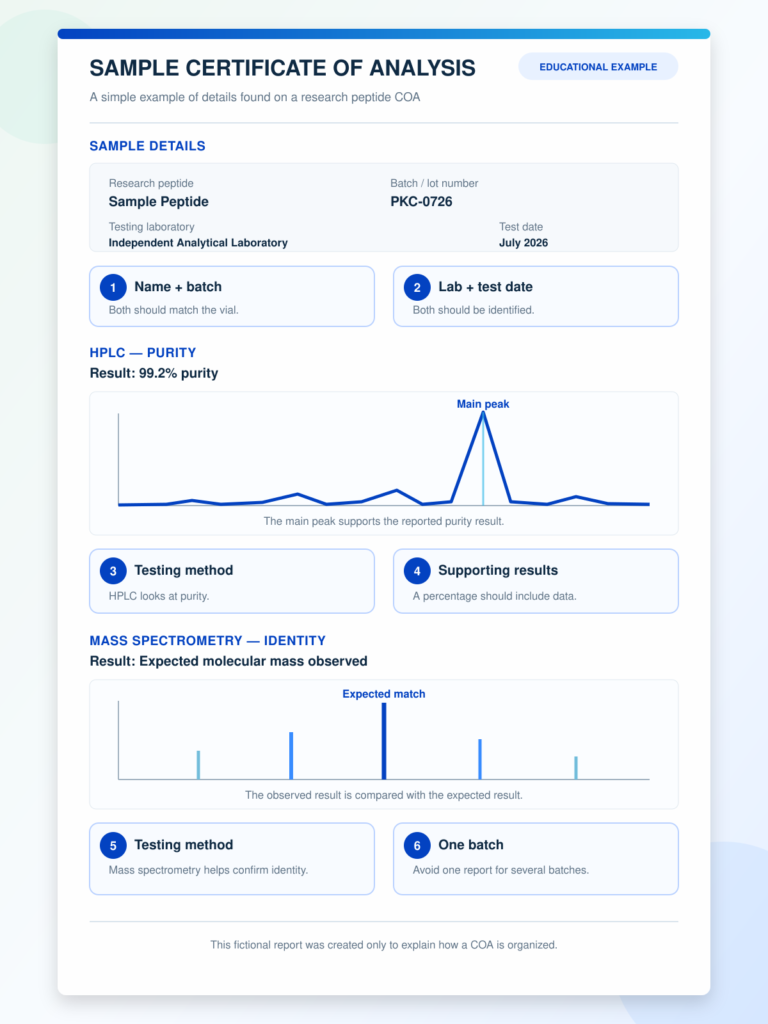
The batch number on the COA should match the number on the research peptide vial. Without that match, it may be difficult to know whether the report belongs to that particular batch.
START WITH THE BASICs
Before looking at percentages or graphs, check the information near the top of the report.
WHAT DO THE TEST RESULTS MEAN?
Two testing methods commonly found on research peptide COAs are HPLC and mass spectrometry. Although they may appear together, they look at different parts of the sample.
HPLC looks at purity
HPLC separates the different components found in a sample. The results help show how much of the detected material is associated with the main research peptide compared with other material.
This is usually where the purity percentage comes from.
Mass spectrometry looks at identity
Mass spectrometry examines the molecular mass of the sample. The laboratory compares the observed result with the expected result for that research peptide.
Put simply, HPLC helps answer, “How pure does the sample appear?” Mass spectrometry helps answer, “Does it appear to be the research peptide named on the report?”
WHAT DOES 99% PURITY MEAN?
A 99% purity result can sound like it tells you everything about a research peptide, but it answers only one part of the quality question.
It generally means that most of the material detected during the purity test was connected to the main component. It does not automatically confirm the amount in the vial, sterility, or how the product was handled after testing.
Purity is useful information. It simply needs to be considered alongside the rest of the report.
DETAILS WORTH A CLOSER LOOK
A COA may deserve a few more questions when:
A professional-looking document is not always a complete one. The information it provides matters more than its design.
WHAT A COA DOESN’T SHOW
A research peptide COA only reports the tests listed on the document.
For example, a report showing purity does not also confirm sterility unless sterility testing is specifically included. It cannot show how every vial in a batch was stored, shipped, or handled after the sample was tested.
The best approach is to focus on what the COA confirms without assuming it answers questions it was not designed to address.
5 Questions to ask
When reviewing a research peptide COA, ask:
- Does the research peptide name match?
- Does the batch or lot number match?
- Is the testing laboratory identified?
- Are the testing methods listed?
- Are the actual results shown?
You do not need to interpret every number or graph. These five questions can tell you a great deal about how complete and useful the report is.
LOOK BEYOND THE PURITY NUMBER
A useful COA clearly identifies the sample, connects it to a specific batch, shows which tests were performed, and provides the results. Once you know where to find those details, the entire document becomes much easier to follow.
KEEP EXPLORING
Understanding HPLC
Learn how laboratories examine research peptide purity.
Mass Spectrometry Explained
See how testing can help confirm a research peptide’s identity.