If you’ve recently started looking into research peptides, you’ve probably noticed one thing pretty quickly: there is a lot of information out there.
One website says one thing. A forum says something else. Then you see products with names you’ve never heard of, and before long it can feel like you’re trying to learn a completely new language.
The truth is, research peptides aren’t as complicated as they sometimes seem. If you’re new to peptide science, this Beginner’s Guide to Research Peptides is a great place to start learning the basics and building a stronger understanding of the topic.
Starting With The Basics
At the simplest level, peptides are naturally occurring molecules made up of amino acids. They’re found throughout nature and play a role in many biological processes.
When people talk about research peptides, they’re usually referring to peptides that are being studied to better understand how they work and what researchers can learn from them.
That’s where much of the growing interest comes from. Peptides are an active area of research, and scientists continue to study them in a variety of ways.
Why Is Everyone Talking About Peptides?
Peptides have become much more visible in recent years, which means more articles, more discussions, and more products than ever before.
For someone new to the topic, that can be both helpful and confusing.
You might see peptide creams, supplements, educational articles, social media posts, and research products all being discussed at the same time. While they may share the word “peptide,” they aren’t necessarily the same thing.
That’s one reason learning the basics is so important. Understanding what you’re looking at helps everything else start to make more sense.
Not All Peptides Are The Same
One common misconception is that peptides are all alike.
In reality, there are many different peptides, each with its own name and unique characteristics. That’s why you’ll see names like BPC-157, TB-500, CJC-1295, Ipamorelin, and many others.
Think of it like vehicles. Cars, trucks, motorcycles, and SUVs are all vehicles, but they’re built differently and serve different purposes. Peptides are similar in that there are many different types being researched and discussed.
As you continue learning, you’ll start to recognize some of the more commonly referenced peptides and understand how they differ from one another.
Understanding Research Products
If you’ve spent any time searching online, you’ve probably noticed that research peptides are often sold differently than many other products.
You’ll commonly see small vials, product labels, and testing information that may seem unfamiliar at first.
This is completely normal.
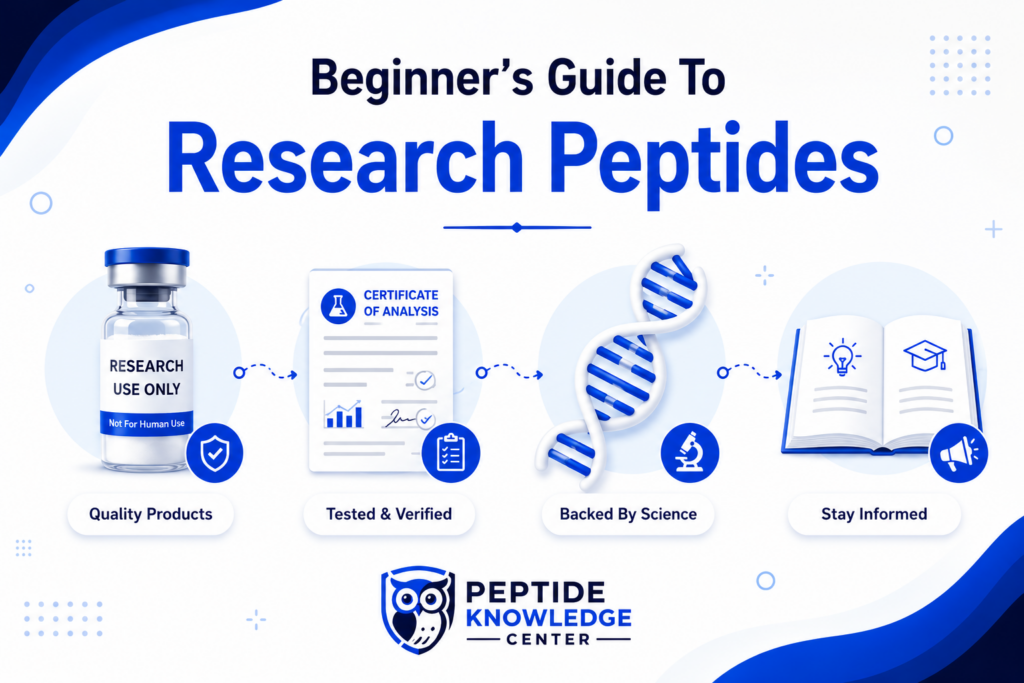
One of the most important things beginners can learn is how to evaluate quality information. That includes understanding product details, learning what testing documents mean, and becoming familiar with Certificates of Analysis, often called COAs.
A little knowledge in this area can go a long way.
Don’t Try To Learn Everything At Once
One mistake many beginners make is trying to understand every peptide, every study, and every scientific term all at the same time.
You don’t need to do that.
Start with the basics. Learn what peptides are. Learn why researchers study them. Learn how testing works and why quality matters. Once those pieces start coming together, the rest becomes much easier to follow.
The goal isn’t to become an expert overnight. The goal is simply to build a solid understanding one step at a time.
Your Learning Journey Starts Here
Research peptides are a fascinating topic, but getting started doesn’t have to feel overwhelming.
The more you learn, the more you’ll realize that peptide science isn’t just about complicated names and scientific terminology. It’s about understanding the fundamentals, asking good questions, and continuing to build your knowledge along the way.
That’s exactly why Peptide Knowledge Center exists—to help make peptide science easier to follow, easier to explore, and easier to understand.