Research peptides come with their own vocabulary. If you have ever looked at a peptide profile, certificate of analysis, or research paper and wondered what terms like purity, sequence, lyophilized, or batch testing actually mean, you are not alone.
Most of these research peptide terms are easier to understand than they first appear. Here are some of the common words and phrases you may come across when learning about research peptides and what they mean in everyday language.
Research Peptide
A research peptide is a short chain of amino acids that is produced or studied for laboratory research. Researchers use peptides to explore how different biological processes work, including signaling between cells, metabolism, tissue repair, immune activity, and hormone-related pathways.
The word research is important. A compound being studied in research does not automatically mean it has been approved as a medication or established as safe or effective for people.
Amino Acid
Amino acids are often described as the building blocks of proteins. Peptides are created when amino acids are linked together in a particular order.
That order matters. Changing even one amino acid can change how a peptide behaves, which is why you will often see a peptide’s amino acid sequence included in scientific information.
Peptide Sequence
The sequence tells you which amino acids make up a peptide and the exact order in which they are connected.
You can think of it a little like spelling a word. The same letters arranged differently can create a completely different word. In a similar way, the arrangement of amino acids helps determine the characteristics of a peptide.
Synthetic Peptide
A synthetic peptide is made through a controlled laboratory process rather than being collected directly from a natural biological source.
Researchers can use peptide synthesis to create specific amino acid sequences for study. Some synthetic peptides are designed to match peptides that occur naturally, while others may be modified versions created to investigate a particular question.
Lyophilized
Lyophilized simply means freeze-dried.
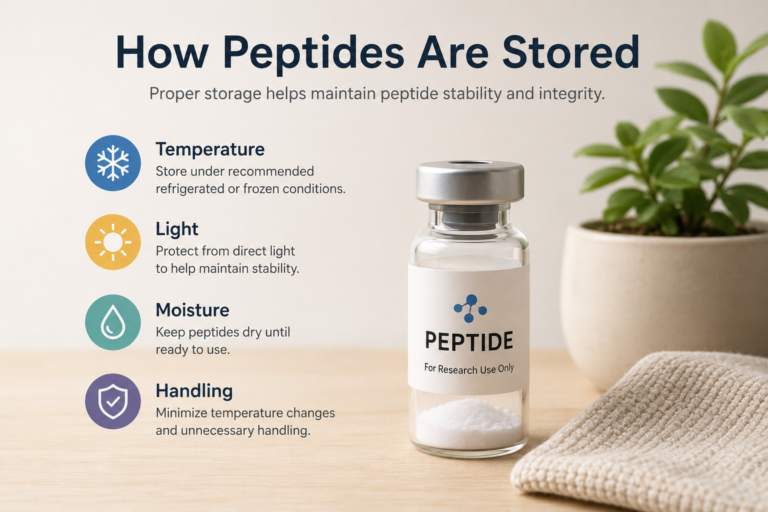
Peptides are often supplied as a dry powder because removing water can help make the material more stable during storage. If you see terms such as lyophilized peptide or lyophilized powder, they are describing this physical form.
Reconstitution
Reconstitution means adding a liquid to a dry material so that it becomes a solution.
You may see the term frequently in peptide discussions because many research peptides are supplied in lyophilized form. The appropriate preparation method depends on the material and the research protocol being used.
Purity
Purity describes how much of a tested sample consists of the intended peptide compared with other detectable components.
For example, a reported purity percentage may come from laboratory analysis designed to separate and measure compounds within a sample. It is useful information, but purity alone does not tell you everything about a peptide.
A high purity result does not automatically confirm identity, concentration, sterility, or suitability for a particular use.
Identity Testing
While purity asks “How much of the sample appears to be the target material?”, identity testing asks “Is this actually the peptide it is supposed to be?”
That distinction is easy to miss. A sample can have a strong purity result while still requiring separate evidence that confirms its identity.
This is one reason it is helpful to look beyond a single percentage when reading peptide testing information.
HPLC
HPLC stands for high-performance liquid chromatography.
Despite the complicated name, its basic purpose is fairly straightforward. HPLC separates components within a sample so they can be analyzed. In peptide testing, it is commonly associated with evaluating purity.
When you see an HPLC result on a testing report, remember that it tells you about what was detected during that particular analysis. It should not automatically be treated as proof of every quality characteristic.
Mass Spectrometry
Mass spectrometry, sometimes shortened to MS, is an analytical technique that measures compounds based on their mass-related characteristics.
In peptide testing, mass spectrometry can help researchers determine whether a sample is consistent with the expected peptide. This makes it particularly useful when investigating identity.
You may also see combined terms such as LC-MS, where liquid chromatography and mass spectrometry are used together.
Certificate of Analysis (COA)
A Certificate of Analysis, usually called a COA, is a document that reports testing information about a particular material or batch.
Depending on the testing performed, a peptide COA might include the peptide name, batch or lot number, purity result, identity information, testing methods, dates, and laboratory information.
Not every COA contains the same tests, so it is worth looking at what was actually measured rather than simply checking whether a COA exists.
Batch or Lot Number
A batch number or lot number is an identifier used to connect a particular group of material with its production and testing records.
This becomes especially useful when reviewing a COA. Ideally, the identifying information on the testing documentation should clearly correspond with the batch being referenced.
Third-Party Testing
Third-party testing means a sample was analyzed by a laboratory or testing organization separate from the company associated with the product.
The phrase sounds reassuring, but it is still worth looking at the details. Who performed the testing? What tests were performed? When was the sample tested? Does the report identify the batch?
Those details usually tell you more than the words “third-party tested” by themselves.
Molecular Weight
Molecular weight is a measurement related to the mass of a molecule.
Because a peptide’s amino acid sequence determines its molecular structure, researchers can calculate an expected molecular weight. Laboratory testing can then help determine whether the characteristics of a sample are consistent with what is expected.
Peptide Analog
An analog is a compound that is similar to another molecule but has been intentionally modified in some way.
Researchers may study peptide analogs to see how changing part of a sequence affects stability, activity, duration, or interactions with biological targets.
This is why two peptides with similar names or purposes are not necessarily identical.
Half-Life
Half-life describes how long it takes for the amount or concentration of a substance to decrease by half under specified conditions.
You will see this term frequently in pharmacology and peptide research. Half-life can vary depending on the compound, the experimental system, and what researchers are measuring, so it should always be understood in context.
Receptor
A receptor is a structure, usually on or inside a cell, that can respond when a particular molecule interacts with it.
Some peptides work as signaling molecules and interact with specific receptors. Researchers study these interactions to better understand what happens after a receptor is activated or blocked.
Agonist and Antagonist
An agonist activates a receptor or produces a response through it. An antagonist blocks or reduces activation of a receptor.
These terms appear often in peptide and pharmaceutical research because understanding receptor activity can help explain what researchers are investigating about a compound.
In Vitro
In vitro generally refers to research performed outside a living organism, such as experiments involving isolated cells, proteins, or other laboratory systems.
These studies can help researchers investigate specific mechanisms under controlled conditions, but their results do not automatically predict what will happen in a complete living organism.
In Vivo
In vivo refers to research conducted within a living organism.
Animal studies are a common example. In vivo research can provide information that cannot always be captured in isolated cells, but results from one species or experimental model should not automatically be assumed to apply to humans.
Preclinical Research
Preclinical research generally happens before a potential treatment reaches human clinical testing.
It can include laboratory experiments, cell studies, animal research, and other work intended to understand how a compound behaves and whether further investigation may be appropriate.
A peptide having preclinical research behind it does not mean it has completed human clinical trials.
Clinical Trial
A clinical trial is a structured research study involving human participants.
Clinical trials typically follow defined protocols and may investigate questions such as safety, dosage, effectiveness, or side effects. Different trial phases answer different questions, and completing early research does not guarantee eventual regulatory approval.
Research-Grade
Research-grade is a term commonly used to describe materials intended for laboratory research.
It should not be confused with regulatory approval or a universal quality standard. When evaluating research materials, specific testing information is generally more useful than relying on the phrase “research-grade” alone.
Why Understanding These Terms Matters
Peptide research becomes much easier to follow once the vocabulary starts making sense. More importantly, knowing these terms can help you ask better questions.
Instead of seeing a purity percentage and assuming it tells the whole story, you can look for identity testing. Instead of simply seeing “third-party tested,” you can check who performed the test and whether the report matches the batch. And when you read about promising research, you can tell whether the findings came from cells, animals, or human clinical trials.
You do not need to become a chemist to understand peptide research. Learning a few of the industry’s most common terms can make it much easier to separate what a source actually tells you from what still needs a closer look.