
DSIP
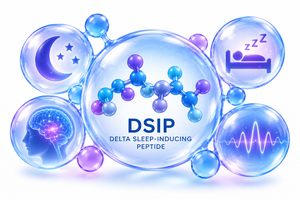
DSIP, short for delta sleep-inducing peptide, is a small research peptide studied for its possible connection to sleep regulation. Researchers have explored its influence on sleep patterns, circadian rhythms, stress-related signaling, and communication within the nervous system.
DSIP AT A GLANCE
WHAT IS DSIP?
DSIP is a short peptide made from nine amino acids. It was first identified during research involving electrical activity associated with sleep, which led scientists to investigate whether it could help regulate sleep and wakefulness.
Researchers have since detected DSIP-like material in the brain, blood, and other tissues. However, its exact natural form and biological role remain uncertain, and scientists have questioned whether the measured material represents DSIP itself or a related molecule.
HOW DOES DSIP WORK?
Scientists have not identified one confirmed receptor or pathway that fully explains how DSIP works. Research suggests it may influence several systems involved in sleep, stress, hormone activity, and communication between nerve cells.
Rather than acting like a traditional sedative, DSIP has been described as a possible regulator of existing biological rhythms. Its effects have varied across studies, species, research conditions, and amounts examined, making its activity difficult to define.
Areas of Research
DSIP research has explored more than sleep alone. Scientists have examined its possible relationship with daily biological rhythms, hormone signaling, stress responses, and nervous-system activity.
SLEEP PATTERNS
Examining possible changes in sleep onset, total sleep time, and different stages of sleep.
DELTA-WAVE ACTIVITY
Studying the slow brain waves commonly associated with deeper stages of non-REM sleep.
CIRCADIAN RHYTHMS
Exploring whether DSIP influences natural patterns that help organize sleeping, waking, and daily activity.
STRESS AND HORMONES
Investigating possible connections between DSIP, stress-related signaling, and the release of certain hormones.
Research Highlights
DSIP has an interesting research history. Scientists began studying it in the 1970s after discovering a possible connection to deep sleep. Since then, researchers have explored whether this small peptide plays a role in sleep patterns, brain activity, and the body’s natural sleep-wake cycle.
What Have Human Studies Found?
Early human studies explored whether DSIP could help people experiencing sleep difficulties.
What Are Researchers Still Trying to Understand?
Scientists still haven’t identified exactly how DSIP works or whether it directly controls sleep. Much of the research is several decades old, and larger, modern human studies are needed to better understand its effects.

WHAT IS DSIP MOST COMMONLY RESEARCHED FOR?
DSIP is most commonly studied for its possible influence on sleep regulation. Researchers have examined whether it affects how quickly sleep begins, how long it lasts, and the amount of time spent in different sleep stages. The findings have been mixed, and its name should not be taken as proof that it consistently induces deep sleep.
HOW DOES DSIP FIT INTO PEPTIDE RESEARCH?
DSIP is part of peptide research exploring how small amino-acid chains may help coordinate activity between the brain, nervous system, and hormones. Its complicated research history also shows how a peptide can receive a descriptive name before scientists fully understand its natural function.
WHAT MAKES DSIP UNIQUE?
DSIP is unusual because researchers have connected it with several biological processes without identifying one clear mechanism that explains them all. Its reported activity has included sleep, circadian rhythms, stress responses, hormone levels, and nervous-system signaling, but many of these findings remain uncertain.
CAN DSIP BE RESEARCHED ALONGSIDE OTHER PEPTIDES?
Researchers may compare DSIP with other peptides studied in connection with sleep, brain signaling, stress, or circadian activity. Related subjects may include Epitalon, Selank, Semax, and Pinealon. Each has a different structure and research history, so they should not be treated as interchangeable.
IS DSIP THE SAME AS MELATONIN?
No. Melatonin is a hormone that helps regulate the body’s sleep-wake cycle, while DSIP is a research peptide being studied for its possible role in sleep regulation. Although both are connected to sleep research, they work differently, and scientists still don’t fully understand how DSIP influences sleep.
HAS DSIP BEEN APPROVED FOR MEDICAL USE?
No. DSIP has not been approved by the FDA to treat insomnia or other medical conditions. Although early studies explored its possible effects on sleep, there isn’t enough reliable clinical evidence to establish its safety or effectiveness as a treatment.